
Sunday, February 2 – Thursday February 4, 2027 | Las Vegas Convention Center, Las Vegas, NV
IBS. KBIS. Design & Construction Week in Las Vegas is not small. It is bold, high-energy, and packed with decision-makers shaping the future of residential building and design.
At NPARALLEL + Atomic Props, we design and build custom trade show exhibits that rise to that moment.
From first concept to final installation, our Minneapolis-based team manages every detail of your DCW presence. IBS halls. KBIS floor. Both sides of the show. Strategy, creative, fabrication, logistics, show-site support. All under one roof.
You focus on builders, architects, designers, and dealers walking your space. We’ll make sure your environment works as hard as you do.
At Design & Construction Week, showing up is one thing.
Showing up with purpose is another.
We’ve got you.
Design & Construction Week (DCW) is the co-located event that brings together the International Builders’ Show® (IBS) and the Kitchen & Bath Industry Show® (KBIS) at the Las Vegas Convention Center, running February 2–4, 2027. NAHB produces IBS; NKBA produces KBIS.
What makes DCW unique is its structure: one registration badge covers access to both exhibit floors. An attendee who badges in for IBS can walk the KBIS floor, and vice versa, creating a combined audience no single show can replicate. The co-location has been in place for over 13 years and is confirmed through at least 2030.
Together, the two shows draw 85,000+ industry professionals, 2,400+ exhibitors, and span more than 1 million net square feet of exhibit space. The 2026 Orlando edition topped 117,000 total attendees. IBS alone brings 1,800+ manufacturers and suppliers across multiple halls at the LVCC; KBIS organizes its exhibitors by product category and design experience area in adjacent halls.
Who attends: single-family and multifamily home builders, remodelers, architects, interior designers, kitchen and bath specialists, dealers, distributors, and residential construction specifiers. Both shows are trade-only events, not open to the general public. At IBS, 89% of attendees are involved in purchasing decisions, and all of the top 50 production builders in the U.S. attended the 2025 show.
85K+ Industry Professionals
2,400+ Exhibitors
1M Sq.Ft Exhibit Space
89% Playing Decision Role
Let’s Talk Investment. The Real Picture.
IBS 2027 indoor booth space begins at $54 per square foot at the early rate. KBIS pricing is set separately by NKBA. And while the two shows happen under one Design & Construction Week umbrella, they are contracted independently. If you are exhibiting at both, that means two applications and two space fees.
But space is just the starting line.
Your total investment includes design, fabrication, graphics, shipping, installation, labor, show services, and all the details that bring your brand to life on the floor. That is where strategy matters.
We walk through this with you early. No surprises. No guesswork. Just a clear, thoughtful plan that aligns your budget with the outcomes you are looking for.
Because this week is big, we create an exhibit experience that works as hard as it possible can for you.
Payment terms: a 50% deposit is required with your application before May 29, 2026. After that date, 100% payment is required upfront. All IBS exhibitors also pay a mandatory $300 Directory & Insurance Fee covering your listing in the Official Show Guide and the required exhibitor liability insurance. Minimum booth size: 100 sq ft indoor, 400 sq ft outdoor.
The industry rule of thumb: budget 3–5x your booth space cost to cover everything required to actually exhibit. Space rental covers your footprint; everything inside and around it’s extra. On top of booth space, plan for exhibit design and fabrication, freight and drayage (material handling at the convention center), electrical and internet, lead retrieval, furniture rental, on-site labor for installation and dismantle, and the mandatory $300 IBS Directory & Insurance Fee. If you’re using music in your booth, NAHB charges a separate licensing fee.
To put it in context: a 400-square-foot IBS indoor booth at the early rate costs $21,600 in space alone. With design, fabrication, freight, and on-site services, the total investment typically lands between $65,000–$110,000+ depending on exhibit complexity. First-time exhibitors and emerging companies should also explore the IBS Start-Up Zone, a $5,200 package including a templated kiosk, 4 exhibitor passes, lead retrieval, and press list inclusion.
Want to understand what your IBS or KBIS exhibit will actually cost from design through move-out?
We can walk you through the complete budget picture. →
Both shows take place at the Las Vegas Convention Center (LVCC) at 3150 Paradise Road in Las Vegas. IBS and KBIS occupy different sections of the campus, which is why hall placement matters before you commit to a booth location. A booth in the wrong segment relative to your product category will underperform even with excellent exhibit design.
IBS organizes exhibitors into product segments to help attendees navigate the show floor. NAHB describes the IBS floor as the size of over 40 football fields. For 2027:
Business Management & Professional Services; Interior Finishings & Home Living; IBS Start-Up Zone
Building Materials
Construction Tools, Systems, Equipment & Safety; Outdoor Living, Leisure & Modular Structure; Global Products (International Pavilions)
Large-format and outdoor products; 400 sq ft minimum; floor plan releasing late Spring 2026
At IBS, booth space is assigned first come, first served after approval. Apply early, and you gain flexibility in hall and segment placement.
But this is not just about grabbing a spot. It is about choosing the right one.
Traffic flow. Buyer clusters. Competitive positioning. We help you evaluate where your audience will be and select a location that supports your goals, not just your footprint.
At a show this big, where you stand shapes how you stand out.
KBIS 2027 hall assignments for the Las Vegas Convention Center haven’t been published yet. In prior Las Vegas editions, KBIS has organized exhibitors by product category across multiple LVCC halls, with dedicated areas for smart home technology, luxury fixtures, and emerging design trends. We’ll update this section with confirmed hall assignments, product category placements, and featured experiences once NKBA publishes the 2027 floor plan at kbis.com.
Earlier than you think. The earliest published deadline for IBS 2027 is March 20, 2026, for early-rate exhibit space applications. Because IBS and KBIS are managed by separate organizations (NAHB and NKBA), the two shows have independent deadline structures. That means separate exhibitor portals, separate service kit timelines, and potentially different move-in windows during the same setup week. Here’s the planning calendar:
| Timeframe | Key Actions | ||
|---|---|---|---|
| 12+ Months | Define show objectives and target audience. Begin booth space application process. Engage an exhibit partner. Join NAHB or NKBA to qualify for member booth rates. | ||
| 9–12 Months | Finalize booth location and size. Begin exhibit design concepting. Book hotel rooms through the official IBS/KBIS hotel block (Las Vegas rates spike during February events). | ||
| 6–9 Months | Approve final exhibit design. Begin fabrication. Plan booth staffing and product demonstrations. | ||
| 3–6 Months | Order electrical, internet, and other utilities through the Exhibitor Service Kit. Coordinate shipping logistics. Plan pre-show marketing and social media. Schedule meetings with key buyers and distributors. | ||
| 1–3 Months | Train booth staff on key messaging and demos. Test all technology and product displays. Confirm all logistics. Pre-schedule meetings through the IBS/KBIS attendee directories. | ||
| Show Week | Installation during the targeted move-in window. On-site execution. Real-time lead capture. Daily team debriefs. | ||
| Post-Show | Lead follow-up within 48 hours. ROI analysis and reporting. Exhibit asset storage and refresh planning for next year. | ||
IBS and KBIS attendees are not casual browsers. They are builders, remodelers, architects, and designers. They work with materials every day. They know quality when they see it. And they bring that trained eye straight onto the show floor.
What works at a tech conference or consumer expo can fall flat here.
At Design & Construction Week, this audience notices craftsmanship. They pay attention to finishes. They test, touch, open, compare. The most effective booths are not just visually bold. They are materially credible, thoughtfully laid out, and built to support real conversations about performance, durability, and application.
We design with that mindset in mind. Because when your audience builds for a living, your exhibit has to feel built with intention.
This audience wants to touch, test, and compare. Working kitchen vignettes with live plumbing, installed flooring underfoot, structural assemblies you can physically interact with, and demonstrated building systems all outperform flat graphics and printed literature.
If your product installs in a home, show it installed. If it requires a demonstration, staff for live demos throughout the show day.
With one badge covering both shows, many attendees are moving between IBS and KBIS floors across a three-day window. By mid-show, they’ve seen hundreds of booths.
A booth that communicates its core value proposition in three seconds captures traffic; one that requires study to understand often doesn’t. Visible product category, clear company name, and a defined booth entry point matter more than visual complexity.
This isn’t a consumer show. The buyers at IBS are placing product orders for homes built 12–24 months from now. Conversations tend to be longer and more substantive, which means your booth needs space for seated meetings, not just walk-by exposure.
Plan for at least one hospitality or conversation zone in any booth 400 sq ft or larger. Many exhibitors pre-schedule meetings and use their booth as a private showroom for key accounts.
KBIS concentrates smart home technology and connected fixtures in the West Hall for a reason: this audience genuinely wants to understand what technology can do in the home. Touchscreen product configurators, AR room renderings, and live connectivity demonstrations perform well for kitchen and bath brands.
On the IBS side, digital tools that make the builder’s job easier (estimation software, project management platforms, specification tools) see strong engagement when demonstrated live.
Understaffing on Day 1. Early traffic volume catches many exhibitors off guard.
Bringing fragile material samples. Samples need to withstand three full days of handling and foot traffic.
Skipping lead retrieval. Relying on business card collection doesn’t scale and makes post-show follow-up harder.
Choosing the wrong hall segment. A booth that doesn’t match its product category will underperform regardless of design quality.
Overlooking IBS sponsorship and advertising add-ons. Exhibitors who participate see an average of 176% more leads.
Planning your DCW Show exhibit? Let’s start the conversation.
Whether you need a large-scale product showroom or an intimate meeting space, we create custom exhibits for every booth configuration:
Every IBS or KBIS exhibit starts with understanding your goals. It’s not just “we need a booth,” but the specific business outcomes you’re trying to achieve.
Our experience design & creative team digs into your target audience, competitive positioning, product hierarchy, and messaging strategy before we sketch a single concept.
Our 160,000 square foot facility in Minneapolis houses designers, engineers, CNC machinists, metalworkers, scenic painters, and fiberglass specialists under one roof. For DCW projects, that means working kitchen setups with live plumbing, load-bearing structural product displays, and architectural-scale millwork are all built, fully assembled, and photographed before they ship. What you approve in renderings is what arrives on the show floor.
The DCW audience expects interactive technology, and we build it in from the start, not as an afterthought. Touchscreen product configurators, AR room visualizations, connected fixture demonstrations, and real-time data displays are designed into the exhibit architecture so they feel native to the experience, not bolted on.
We handle shipping, freight coordination, drayage management, union labor coordination at LVCC, installation, and dismantle. We track both the IBS and KBIS Exhibitor Portal deadlines so you don’t have to manage two separate logistics timelines. Our proprietary project management platform, NPX, keeps clients informed at every stage without requiring you to chase status updates.


There is no universal answer. It depends on how often you exhibit, how your budget is structured, and how central DCW is to your sales strategy.
We help you look at the bigger picture. Frequency, long-term asset value, and total investment over time. Then we guide you toward the option that works hardest for your goals.
Here is how each path plays out.
If you’re committed to exhibiting at IBS or KBIS for multiple years, need a design that’s uniquely yours, or require specialized features like working plumbing, live product demos, or large-format construction displays, a custom-built exhibit gives you the most control and impact.
Custom exhibits also make sense when you attend several trade shows annually and want a design that can adapt across different floor plans.
If this is your first time at IBS or KBIS, you’re working within a tighter budget, or you’re testing the building products or kitchen/bath channel before committing long-term, a rental exhibit keeps your investment lower while still giving you a professional presence.
Our Rent & Reuse program gives you a custom look with rental economics. We design a booth tailored to your brand using components from our inventory, so it looks purpose-built without the full custom price tag.
Not sure which direction makes sense for you?
We can walk you through the options based on your goals and budget. →
If you’ve never exhibited at Design & Construction Week before, here’s what to know up front.
1
IBS and KBIS are two separate shows with separate organizers, applications, and service kits. You contract with each independently.
• Apply as soon as applications open to maximize your location options
• IBS booth selection is first-come, first-served after approval; early applications lock in lower rates
• Book your hotel through the official DCW block; Las Vegas rates spike during February events
Consider the IBS Start-Up Zone if you’re an emerging company ($5,200 includes a templated kiosk, 4 exhibitor passes, lead retrieval, and press list inclusion).
2
Your first DCW booth doesn’t have to be massive to be effective. A focused 10×10 or 10×20 will outperform a larger space with no clear story.
• Lead with one or two hero products, not your full catalog
• Include a live demo or sampling station; IBS and KBIS buyers want to see, touch, and test
• Make your product category obvious at a glance; buyers navigate the floor by need, not by exhibitor name
Good lighting and clear messaging do more than extra square footage.
3
Don’t rely on foot traffic alone. The exhibitors who get the most out of DCW are the ones who do the work before and after the show.
• Use IBS and KBIS pre-show marketing tools for email, social, and direct outreach
• Pre-schedule meetings through the attendee directories
• Have a lead capture system (NP CAPTURE or otherwise) set up before you arrive
Follow up within 48 hours. The conversation goes cold fast after a big show.
One opportunity we always highlight for first-time exhibitors: approach DCW as a sales-driving event, not just a marketing moment.
IBS and KBIS attract a high-intent audience actively searching for products and vendor partners. When you show up ready, with smart lead retrieval, the right staffing plan, and a clear post-show follow-up strategy, the impact multiplies.
This is where conversations turn into specifications. Where relationships turn into revenue.
Plan for that momentum, and the show works harder for you.
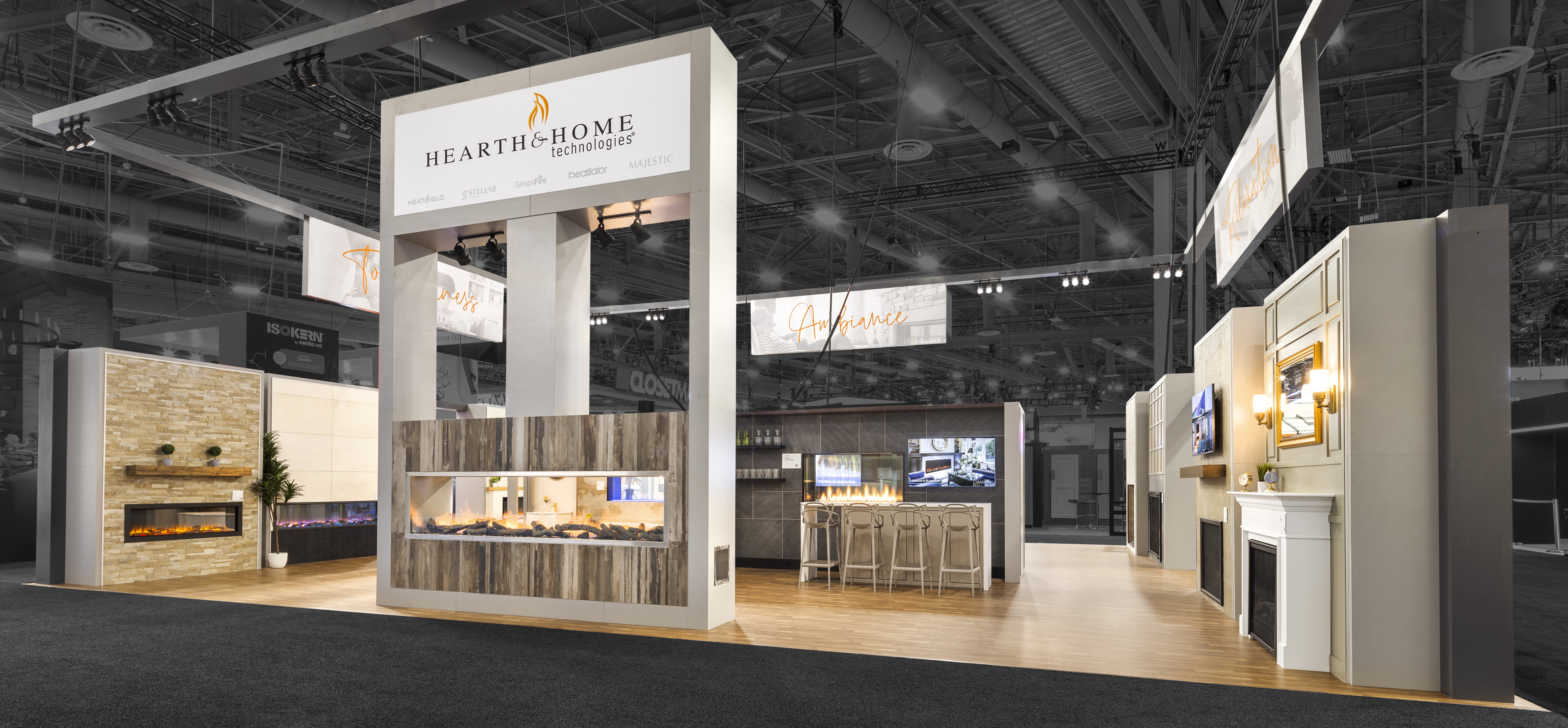
When Hearth & Home Technologies brought Heat & Glo to the International Builders’ Show, the goal wasn’t just to showcase fireplaces. They needed a single exhibit that could function as a product showroom, an internal sales training facility, a content creation studio, and a private meeting space for partners and customers.

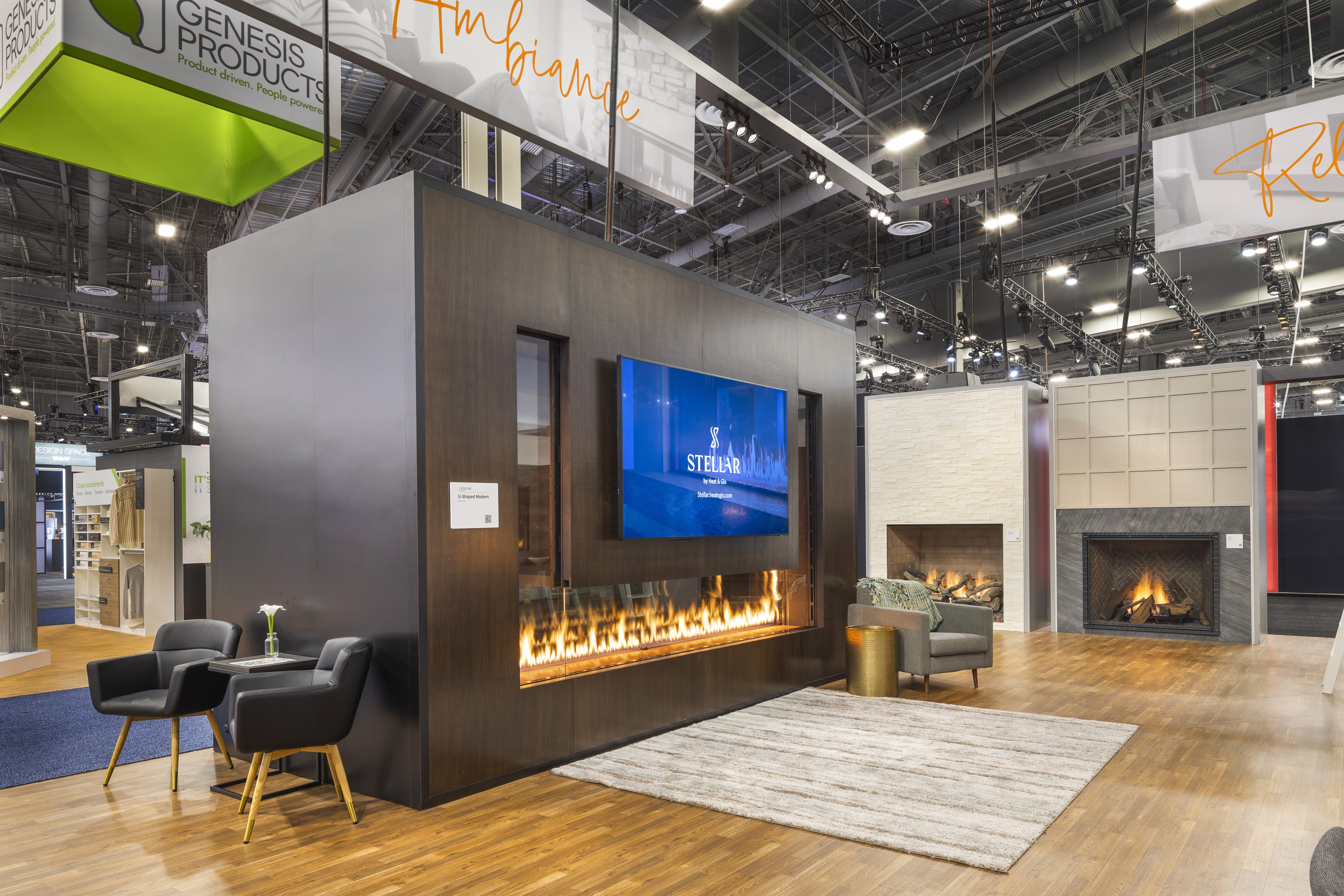
We designed a booth that blended open display areas with intimate meeting zones. Fireplaces were built into lifestyle vignettes that gave each product realistic context and doubled as visually compelling backdrops for on-site content shoots. The layout was intentional: the exhibit hosted pre-show sales trainings for the Hearth & Home team before doors opened, then transitioned to daily hosted sessions with partners and customers during show hours.
The result was a booth that worked before, during, and after show hours. From live workshops and private meetings to new product photoshoots, the exhibit was used across departments, serving as an educational space, content studio, and sales tool simultaneously.
Yes. Design & Construction Week registration provides cross-show access. A single badge admits exhibitors and attendees to both the IBS and KBIS show floors throughout the show. Booth space is still contracted separately with NAHB and NKBA, but staff and visitors move freely between halls. Co-location is confirmed through 2030.
One free exhibitor badge per 25 square feet of contracted exhibit space. Once you’ve used your allotment, you can buy additional badges equal to 50% of your free allotment at $25 each, and a second 50% at $75 each. Beyond that, additional staff must register as attendees and pay applicable attendee rates.
Yes. EACs (Exhibitor Appointed Contractors) are permitted, but for multi-level or covered exhibits, your EAC must submit booth plans to the LVCC Safety and Fire Prevention Office at least 30 days before the first day of move-in. Plans approved for prior shows must be resubmitted each year. EACs and any subcontractors also need certificates of insurance naming NAHB, Emerald Expositions, and the LVCC as additional insureds.
Your booth comes with $1M per occurrence / $2M aggregate commercial general liability coverage through the mandatory $300 IBS Directory & Insurance Fee. Coverage runs through Rainprotection and names NAHB and the LVCC as additional insureds. You’re separately responsible for workers’ compensation and employer’s liability insurance per the laws of the state where you’re incorporated. EACs, production crews, and any contractors you engage need their own COIs.
Anything involving open flame, hot work, gas, or LPG requires advance approval from the LVCC Safety and Fire Prevention Office and a permit from the Clark County Department of Building and Fire Prevention. LPG containers are capped at 12 lb water capacity, can’t be stored overnight, and open flame devices need 24-inch clearance and a non-combustible enclosure. Submit demo plans early. Approvals can take several weeks. Live water and electrical demos are common at IBS and KBIS but still need to be coordinated through the Exhibitor Service Kit.
Yes. NAHB holds the ASCAP and BMI public-performance licenses for the show. They’ll bill you a flat $100 one-time fee for any recorded music in the booth (including video soundtracks, background playlists, and digital presentations), or $300 per day for live music performances. If you don’t plan to play any music or audio, you can opt out, but that includes muting any video content.
Show days run Tuesday February 2 through Thursday February 4, 2027. NAHB’s authorized on-site window for production crews is January 26 through February 6, 2027, which closely mirrors the broader install and dismantle window. All exhibits must remain staffed and fully intact until 5:00 PM Thursday February 4. Premature dismantling triggers penalties under the exhibitor agreement. Targeted move-in dates by booth size will be published in the Freeman IBS Online Service Manual in July 2026.
The Freeman IBS Online Service Manual publishes in July 2026 for the 2027 show. It covers audio visual, exhibit packages, flooring, furnishings, utilities, electrical, shipping, advance warehouse cutoffs, and on-site labor pricing. KBIS publishes its Exhibitor Resource Center separately at kbis.com. Build your detailed budget after both kits are live, not before.
IBS provides 8-foot rear-wall and 3-foot sidewall pipe-and-drape for in-line booths at no cost. You can build to the full cubic content of your contracted space. Any rear-wall above 8 feet, or any sidewall above 3 feet facing a neighboring booth, must be finished. It also can’t display your company name, logo, or advertising on the side facing your neighbor. Multi-level and covered exhibits require the advance plan approval described above.
Building materials, kitchen fixtures, and residential construction products don’t display the same way consumer electronics or packaged goods do. Structural products need to be load-tested on the floor. Working kitchen and bath installations require live plumbing and electrical inside a temporary structure. Material samples need to survive three days of contractors handling them, not three days of attendees tapping a screen. The exhibit itself has to function as a showroom and a sales floor simultaneously.
NPARALLEL + Atomic Props has built exhibits that demonstrate structural systems, operate live plumbing, and display architectural-scale millwork within IBS and KBIS booth construction parameters. We understand the difference between designing for a builder audience evaluating installation efficiency and a designer audience evaluating aesthetics and trends, and we know what it takes when both audiences are on the same campus the same week.
If you’re preparing for your first DCW, or looking to strengthen your results at a show you’ve attended for years, let’s talk.
February 2027 will be here before you know it. And when you layer in strategic concepting, design development, custom fabrication, and freight coordination, the runway matters.
DCW is one stop on a long calendar of trade shows and conferences we build for. The pattern is consistent: start the conversation early and you get options. Better booth location flexibility. Smarter design scope decisions. A budget structure that works with intention, not urgency.
Give the process space to breathe, and we can build something bold, thoughtful, and built to perform.
We’re ready when you are.